 EN
APP Waterproof Membrane: High-Temperature Stability Guide
2026/11/20
How an APP waterproof membrane handles heat: 130°C softening point, torch application windows, overheating signs, summer storage, and thermal aging checks.

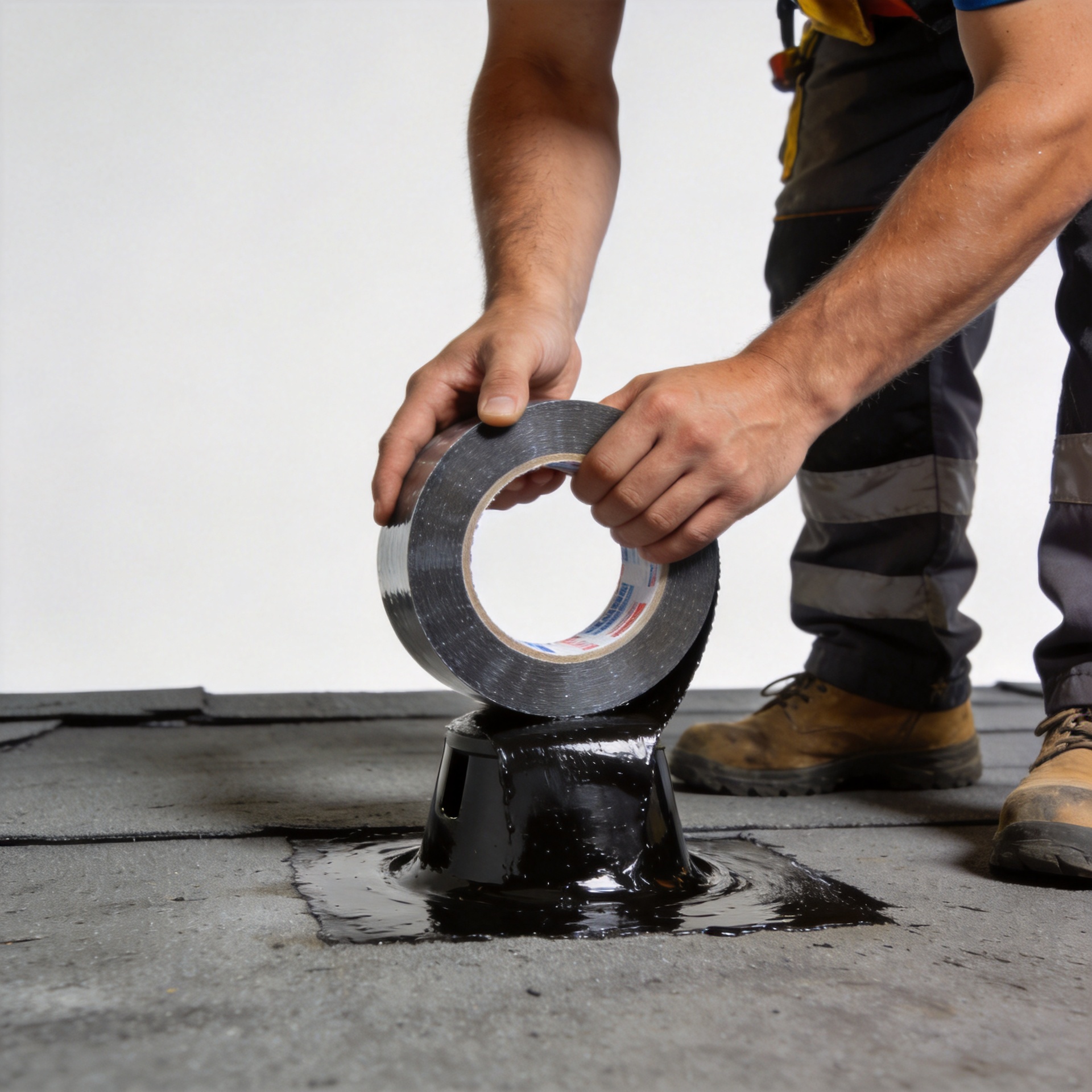
Cold applied bitumen self adhesive waterproofing tape is a pressure-sensitive strip, not a sheet. It closes the places where a membrane system stops being continuous, without flame. This guide maps those uses, then what the format buys, and where a bitumen waterproof tape stops being right.
The strip carries a modified bitumen or butyl compound on a foil or film facing under a liner. Cold applied means no kettle, no torch and no curing window: the bond forms when pressed, so a cold applied bitumen self adhesive waterproofing tape sits between a mastic and a membrane. A mastic fills a gap on three adhesive faces; a strip bridges the joint with its own waterproof layer.
Movement separates them, which is why a butyl waterproof tape on a flexible carrier survives a joint that would tear a sealant. The same reason keeps a self adhesive flashing tape at details, and a roof seam sealing tape on laps rather than on the pan.
A reinforced roof holds hundreds of metres of lap, each a leak path. Running a cold applied bitumen self adhesive waterproofing tape across a lap adds a secondary seal without heat, which makes refurbishment possible where the old sheet cannot take flame. Width follows the lap: on a 100mm side lap, a bitumen waterproof tape of the same width, centred, leaves equal bite on both edges.
The 1.2mm PE-faced grade is the usual pick, thin enough to sit under a later layer, with at least 1.2 N/mm peel adhesion to hold position while the next roll is placed. On metal, a roof seam sealing tape of 100mm to 300mm covers a standing seam without bridging the pan, and a lap wants a plain strip rather than a foil-faced sheet.
The detail that fails most often takes water from two directions. A parapet cap has a horizontal face, a vertical leg and a termination that water runs down. A self adhesive flashing tape with an aluminium foil face covers that geometry in one piece, and the foil reflects sun while resisting UV.
The published foil grade is 1.5mm thick, with peel adhesion of at least 1.5 N/mm and tensile strength of at least 400 N/50mm, in widths from 100mm to 600mm. A 300mm roll covers a stepped flashing and upstand without a longitudinal joint, where a bitumen waterproof tape usually fails. The same foil-faced roof seam sealing tape closes ridge caps above. Supplied as a cold applied bitumen self adhesive waterproofing tape, it also bonds to a rendered parapet without primer.
A pipe through a deck is a hole with a moving edge. Sheet cannot be dressed around a collar without folds, and folds hold water. Wrapping the collar with a butyl waterproof tape in overlapping segments makes a gasket that follows the pipe and bonds to the deck; because the compound stays tacky, a puncture closes.
This duty is chosen on elongation rather than strength: the 1.2mm grade carries at least 300 percent at break, works from -40°C to +70°C, in 50mm to 200mm widths. A 2.0mm heavy-duty butyl waterproof tape, up to 1000mm wide at 2.0 N/mm peel adhesion, spans the structural penetrations where a narrow strip or a roof seam sealing tape cannot reach both sides.
Four formats of bitumen waterproof tape are published, and no two interchange. At the light end, a 1.2mm cold applied bitumen self adhesive waterproofing tape gives at least 1.2 N/mm and 300 N/50mm in 50mm to 300mm widths, with slitting to 1000mm. The 1.5mm foil grade moves to at least 1.5 N/mm and 400 N/50mm for exposed work, 100mm to 600mm wide.
Butyl is chosen where the joint moves, so a butyl waterproof tape is measured by its 300 percent elongation rather than by tensile strength alone. Choosing a self adhesive flashing tape starts from substrate and movement, then the width against the drawing, because a roof seam sealing tape 25mm too narrow lifts at the edge long before the compound fails.
The first benefit is the permit: a cold applied bitumen self adhesive waterproofing tape removes hot work, fire watch and cylinder from the method statement, which decides the programme in occupied buildings. The second is timing: the strip is watertight on contact, so a night leak closes before the crew leaves.
The third is temperature, because a butyl waterproof tape rated from -40°C installs when liquids have stopped. The fourth is inspection: a bitumen waterproof tape has a visible edge, so coverage shows without a gauge. A contractor resealing ridge laps on a cold-store roof in late autumn closed 60 linear metres in an afternoon with a roof seam sealing tape and no heat source, a self adhesive flashing tape on the ridge and no permit to chase.
No. It assumes a substrate that already sheds water. Used as a field membrane, cost rises, seams multiply, and a cold applied bitumen self adhesive waterproofing tape becomes the wrong economics; a roof seam sealing tape cannot be that layer.
Instantly, in the sense that a bitumen waterproof tape is watertight once pressed. Wet-out into a rough substrate takes longer, so pressure and cleanliness beat any waiting period.
Poorly. A butyl waterproof tape needs a dry, dust-free surface for the compound to wet out, or it bonds at the edges and lifts in the middle. A cold applied bitumen self adhesive waterproofing tape is no different, and no self adhesive flashing tape compensates.

2026/11/20
How an APP waterproof membrane handles heat: 130°C softening point, torch application windows, overheating signs, summer storage, and thermal aging checks.

2026/11/20
The science of a breathable waterproof membrane: water vapor diffusion, Sd values, three grammage grades, water column resistance, and wrong-use cases.

2026/11/20
Single-ply or two-ply, every flat roof is a stack. See how a self adhesive waterproof membrane for roof systems handles base, cap, insulation and drains.

2026/11/20
How the polyester scrim sets tensile strength and dimensional stability of reinforced TPO membrane rolls, with welding, roll sizes and selection tips.

2026/11/20
How an aluminum foil coated bitumen waterproof membrane reflects solar radiation, lowers surface temperature, and what maintenance keeps savings alive.

2026/11/20
SBS modified bitumen waterproof membrane property groups: tensile strength, low-temperature flexibility, heat resistance, surface finishes, applications.
Links to the corresponding full news page.

The eight questions overseas buyers ask most — factory ownership, capacity, batch consistency and lead times, answered straight.

SBS membranes, polymer sheets, coatings and geomembranes — six product lines are operating simultaneously.

Pre-sales specification, on-site technical support and post-delivery maintenance across 100+ export markets.

Waterproofing performance is decided in the specification and the detailing, not just the material. Our technical team helps you select the right system, resolve site questions as they arise, and stay reachable long after the container lands.
