 EN
APP Waterproof Membrane: High-Temperature Stability Guide
2026/11/20
How an APP waterproof membrane handles heat: 130°C softening point, torch application windows, overheating signs, summer storage, and thermal aging checks.

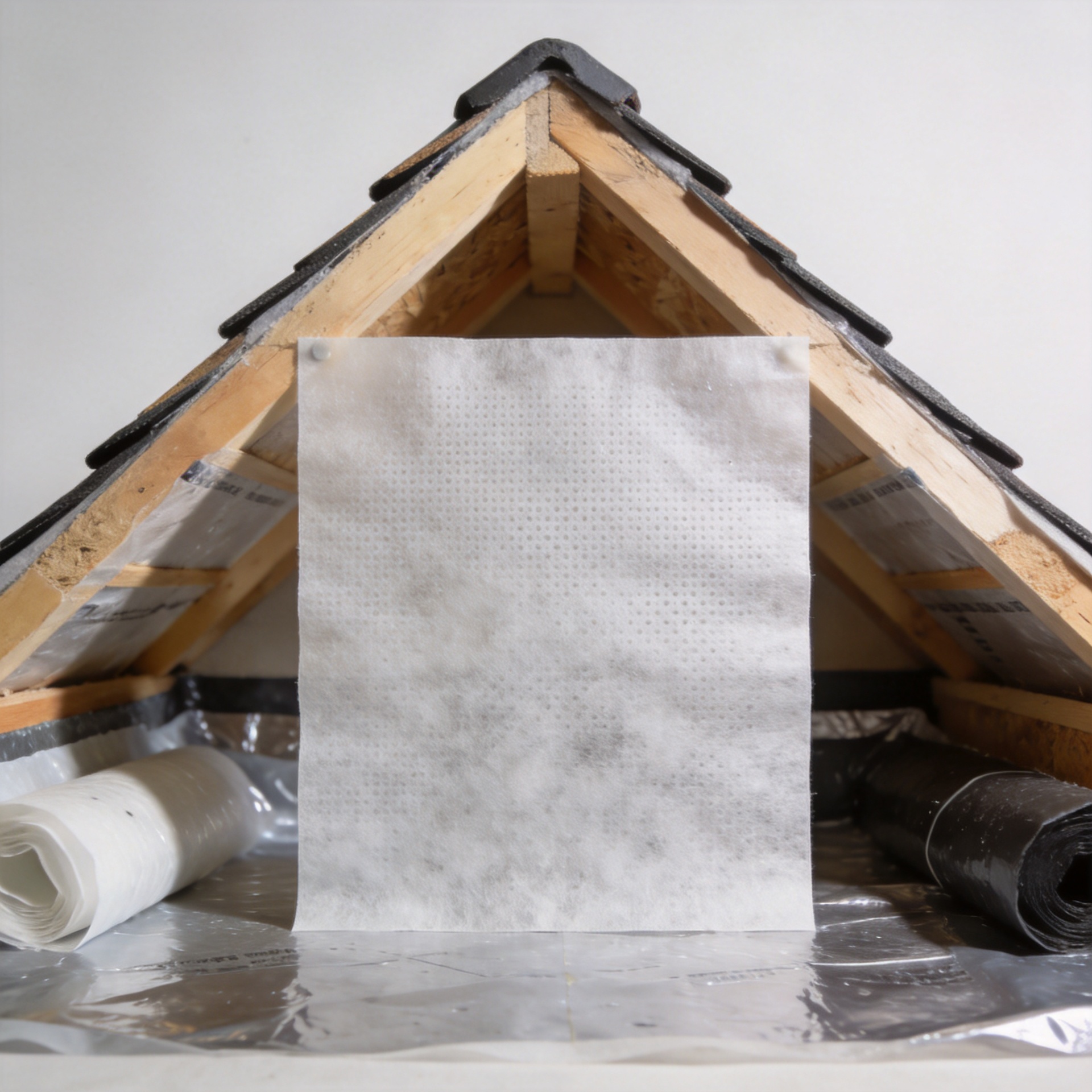
A roof that stays dry inside while moisture escapes from the building structure sounds like a contradiction, yet it is routine physics. The behaviour comes from pore geometry inside the film, not from a surface coating, and that geometry explains why one underlay suits a wind-driven roof while another suits a sheltered wall. This article explains how a micro-porous breathable waterproof membrane sheet separates liquid water from water vapor, why vapor diffusion runs fast through air and slowly through polymer, and how hydrostatic resistance is traded against breathability.
Liquid water is a connected mass held together by surface tension. To enter an opening it must deform, and the narrower the opening, the more pressure is needed to push it through. Water vapor is different: individual molecules, far smaller than any droplet, drift from higher vapor pressure to lower. A breathable membrane with small, interconnected voids therefore passes vapor while resisting liquid water at ordinary service pressure. That contrast is the whole mechanism. Once the head exceeds what the pore network can hold, water crosses, which is why hydrostatic resistance is measured.
A micro-porous breathable waterproof membrane sheet forms a tortuous void network inside a polymer core, and vapor diffusion through the air is fast. The weakness is physical: surfactants, oils, and sustained pressure can wet out the openings, and fine dust lodges inside. A hydrophilic breathable membrane holds no voids at all; moisture dissolves into the polymer and migrates along molecular chains. Nothing can block a pore, so performance holds in dirty conditions, but permeability per unit thickness is lower. Such products arrive as a thin coating on a support fabric, since the solid polymer path is slower.
Pore size and path length pull against each other. Finer voids and a longer route raise hydrostatic resistance but slow vapor diffusion. Thickness adds mechanical reserve and mass together, so manufacturers balance three variables and sell in grades. At 70–100 g/m² a micro-porous breathable waterproof membrane sheet holds ≥ 1,000 mm H₂O and ≥ 80 N/50 mm. At 130–180 g/m² it reaches ≥ 1,500 mm and ≥ 150 N/50 mm. At 220–300 g/m² it delivers ≥ 2,000 mm and ≥ 250 N/50 mm. In a breathable membrane the outer polypropylene layers carry tensile load, while the polyethylene core and its pore structure set watertightness and vapor permeability together.
Sd converts vapor resistance into an equivalent thickness of still air, separate from hydrostatic resistance, so a low figure means an open sheet. Vapor diffusion is what it measures indirectly. At ≤ 0.02 m this family sits in the highly vapor-open class cited by EN 13859, and all three grades share the number. Buyers assume heavier rolls breathe less; here the extra mass sits in the polypropylene skins, so permeability stays level. A micro-porous breathable waterproof membrane sheet is still only one layer of an assembly, though. Insulation, cavity ventilation, and the drying path decide whether a roof dries, and an open breathable membrane cannot rescue a design that traps moisture.
The openings that make the sheet work are also its vulnerability. Cement slurry from rendering, paint overspray, plant oil, fine dust, and biological growth can coat or fill the surface. The local result is a rise in vapor resistance exactly where the contamination sits, which blocks vapor diffusion and reappears later as a damp patch or condensation on a cold bridge. Hydrostatic resistance is unaffected. Most cases trace back to handling: rolls left on wet ground, membrane walked over in muddy boots. Keep a micro-porous breathable waterproof membrane sheet in its wrapper until the deck is swept and dry. A breathable membrane that has absorbed mortar splash will not release it.
Exposure decides the grade. A sheltered pitched roof closed within weeks is served by the lightweight roll. Steeper pitches, curtain walls, and timber frames justify the medium grade for fixing strength and steady vapor diffusion. Coastal sites, high-wind zones, heavy timber, and programmes where cladding slips past three months call for the heavy breathable membrane, rated for six months of direct exposure, with the hydrostatic resistance margin exposed sites need. Standard width is 1.5 m and the minimum order is 10,000 m².
One project team met this on an agricultural shed where steel cladding arrived late and the underlay sat through a windy spring. They specified the heavy grade; the micro-porous breathable waterproof membrane sheet held at the fixings without tearing while vapor diffusion carried moisture from the livestock area below. A lighter breathable membrane would have cost less on day one and far more by the time the roof closed, and the same reading applies to hydrostatic resistance on exposed sites, where tolerance is small.
No sheet blocks water at every pressure. The rating defines the head it resists: ≥ 1,000 mm H₂O on the light grade, ≥ 1,500 mm on the medium, and ≥ 2,000 mm on the heavy grade. Above those heads, hydrostatic resistance is exceeded and water crosses.
No. All three grades are rated at Sd ≤ 0.02 m. Extra weight sits in the polypropylene outer layers, which carry tensile load, while a breathable membrane keeps its vapor permeability through the polyethylene core unchanged.
Loose dust can be brushed off before cladding. Once mortar, paint, or oil has entered the pores, vapor diffusion in that area drops and the patch cannot be restored reliably, so protection during the build is the practical control.

2026/11/20
How an APP waterproof membrane handles heat: 130°C softening point, torch application windows, overheating signs, summer storage, and thermal aging checks.

2026/11/20
The science of a breathable waterproof membrane: water vapor diffusion, Sd values, three grammage grades, water column resistance, and wrong-use cases.

2026/11/20
Single-ply or two-ply, every flat roof is a stack. See how a self adhesive waterproof membrane for roof systems handles base, cap, insulation and drains.

2026/11/20
How the polyester scrim sets tensile strength and dimensional stability of reinforced TPO membrane rolls, with welding, roll sizes and selection tips.

2026/11/20
How an aluminum foil coated bitumen waterproof membrane reflects solar radiation, lowers surface temperature, and what maintenance keeps savings alive.

2026/11/20
SBS modified bitumen waterproof membrane property groups: tensile strength, low-temperature flexibility, heat resistance, surface finishes, applications.
Links to the corresponding full news page.

The eight questions overseas buyers ask most — factory ownership, capacity, batch consistency and lead times, answered straight.

SBS membranes, polymer sheets, coatings and geomembranes — six product lines are operating simultaneously.

Pre-sales specification, on-site technical support and post-delivery maintenance across 100+ export markets.

Waterproofing performance is decided in the specification and the detailing, not just the material. Our technical team helps you select the right system, resolve site questions as they arise, and stay reachable long after the container lands.
