 EN
APP Waterproof Membrane: High-Temperature Stability Guide
2026/11/20
How an APP waterproof membrane handles heat: 130°C softening point, torch application windows, overheating signs, summer storage, and thermal aging checks.

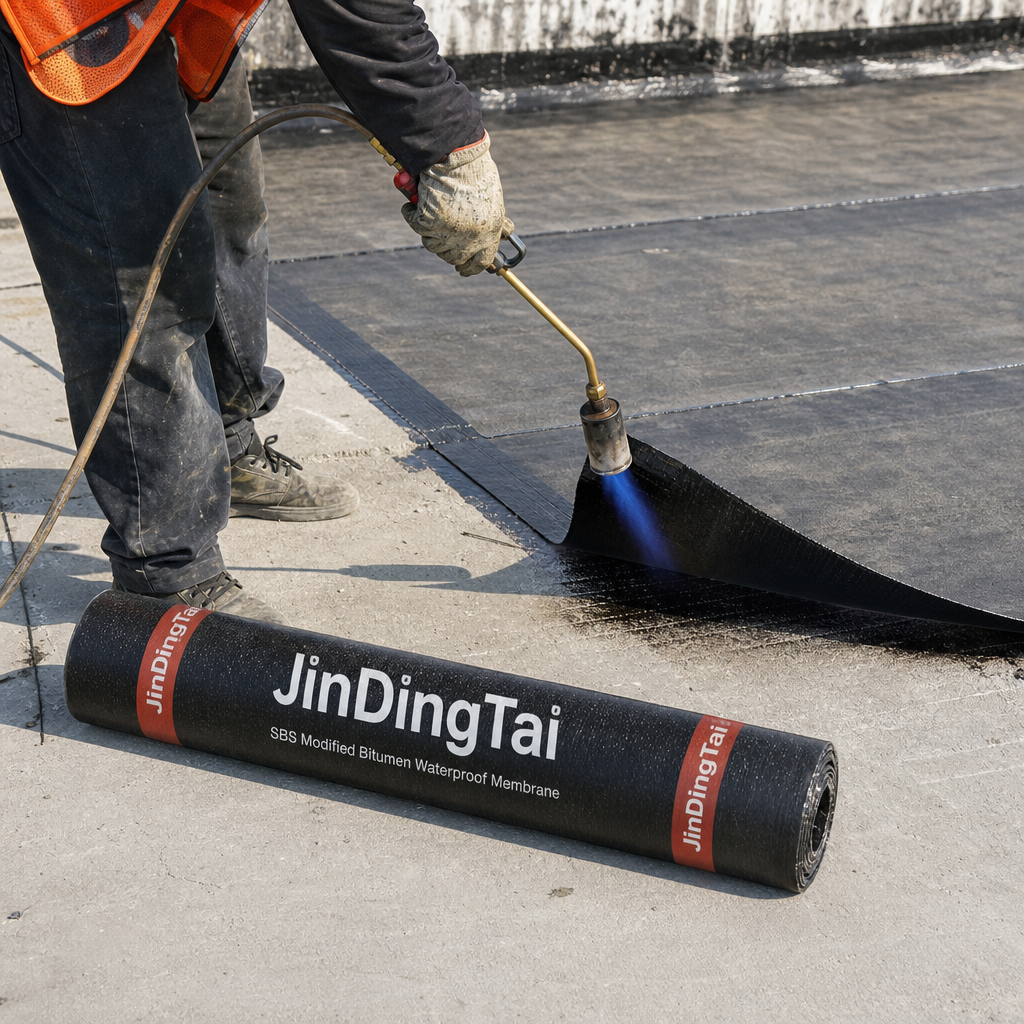
Bitumen on its own is brittle in winter and slow in summer. Polymer modification changes both ends of that behaviour, and the two polymers that dominate the market do it in opposite ways. This overview sets the chemistry of a polymer modified bitumen waterproofing membrane beside its published figures, compares an SBS modified bitumen membrane with an APP modified bitumen membrane, and maps where each type sits in a build-up. Both are torchable, both are tested to the same standards, and both are sold by the roll.
Bitumen is a mixture of hydrocarbons whose stiffness depends on temperature. Add a polymer and the binder gains a second network that resists that dependence. SBS, styrene-butadiene-styrene, is a block copolymer: the styrene ends cluster into domains while the butadiene mid-blocks stay flexible, so the modified binder behaves like a rubber that needed no curing. APP, atactic polypropylene, is a by-product of polypropylene production; it forms a crystalline phase in the bitumen that stiffens the binder and lifts its softening point. The first behaves as an elastomeric bitumen membrane, the second as a plastomeric bitumen sheet. Both remain bitumen, and a polymer modified bitumen waterproofing membrane of either family still needs a carrier. Chemistry sets the ceiling; the carrier decides how much of it reaches site.
The difference shows in recovery. Stretch an SBS modified bitumen membrane and it returns; stretch an APP sheet and it stays where it was put. That single behaviour explains the rest. Elastic recovery in a polymer modified bitumen waterproofing membrane lets an SBS sheet absorb thermal contraction and substrate movement, which is why its low-temperature flexibility reaches -25°C. The crystalline network in an APP modified bitumen membrane resists flow instead, which is why its softening point reaches 130°C while its low-temperature flexibility stops at -5°C or -10°C. Neither wins in the abstract: an elastomeric bitumen membrane follows movement, and a plastomeric bitumen sheet resists heat. That difference is measurable.
Read side by side, the two product pages of a polymer modified bitumen waterproofing membrane describe the split clearly. The SBS modified bitumen membrane lists tensile strength of at least 800 N/50mm, elongation at break of at least 40%, heat resistance of 90°C and flexibility at -25°C. The APP modified bitumen membrane lists tensile strength of at least 600 N/50mm, elongation of at least 25%, a softening point of 130°C and flexibility at -5°C or -10°C. Reinforcement explains part of the gap, since polyester mat carries more load than fiberglass at equal thickness. The rest is the polymer, and that is where an elastomeric bitumen membrane and a plastomeric bitumen sheet part company. The pairing of modifier and carrier is what a certificate tests.
Both families of polymer modified bitumen waterproofing membrane ship in 3mm, 4mm and 5mm grades on polyester mat, fiberglass or composite carriers. Polyester contributes elongation and puncture resistance, suiting roofs that move and decks that see traffic; fiberglass contributes dimensional stability, suiting base layers in multi-ply systems. An elastomeric bitumen membrane usually takes polyester, while a plastomeric bitumen sheet can work with either carrier. Thickness is a separate variable from chemistry. A 5mm APP modified bitumen membrane is not more elastic than a 3mm SBS modified bitumen membrane; it is simply thicker. Reading grade, carrier and modifier together is the honest way to compare two rolls.
The published figures map onto climate clearly. A hot, exposed roof, a tropical warehouse or a sun-facing parapet puts the cap sheet in 130°C softening territory, which is APP ground. A cold-store roof, a northern terrace or a bridge deck in a continental climate asks for recovery at -25°C, which is SBS ground. Underground work favours elongation, since settlement is the dominant load, so an elastomeric bitumen membrane is the usual choice against a retaining wall. Base layers in multi-ply systems take either family, and a plastomeric bitumen sheet is common there, because the cap sheet carries the exposure. Position matters as much as climate: the same polymer modified bitumen waterproofing membrane behaves differently as a cap and as a base. On a cold-store hub, the deck ran hot in summer while the interior froze, so the cap took APP and the base took SBS.
Both products are tested against GB 18242 and EN 13707, and both are certified per thickness grade rather than per family. That detail trips buyers: a certificate for a 4mm SBS modified bitumen membrane says nothing about the 3mm roll, or about an APP modified bitumen membrane of the same thickness. Ask for the declaration, the batch COA and the TDS to name one grade, and check that the low-temperature figure belongs to the sheet being shipped; a polymer modified bitumen waterproofing membrane is only as traceable as the grade on the order. Shandong Dingtai Waterproof issues the package with export orders. A plastomeric bitumen sheet bought on a family name rather than a grade is a specification waiting to be argued about on site.
No. The -25°C figure belongs to specific grades, and a polymer modified bitumen waterproofing membrane in a light colour may still need heat resistance that SBS cannot offer at 90°C.
Yes. A common build-up pairs an APP modified bitumen membrane cap with an SBS modified bitumen membrane base, so the exposed surface resists heat while the lower layer absorbs movement.
Both are commonly torch-applied, and an elastomeric bitumen membrane also appears in cold-adhesive versions. The modifier changes the temperature envelope, not the installation family.

2026/11/20
How an APP waterproof membrane handles heat: 130°C softening point, torch application windows, overheating signs, summer storage, and thermal aging checks.

2026/11/20
The science of a breathable waterproof membrane: water vapor diffusion, Sd values, three grammage grades, water column resistance, and wrong-use cases.

2026/11/20
Single-ply or two-ply, every flat roof is a stack. See how a self adhesive waterproof membrane for roof systems handles base, cap, insulation and drains.

2026/11/20
How the polyester scrim sets tensile strength and dimensional stability of reinforced TPO membrane rolls, with welding, roll sizes and selection tips.

2026/11/20
How an aluminum foil coated bitumen waterproof membrane reflects solar radiation, lowers surface temperature, and what maintenance keeps savings alive.

2026/11/20
SBS modified bitumen waterproof membrane property groups: tensile strength, low-temperature flexibility, heat resistance, surface finishes, applications.
Links to the corresponding full news page.

The eight questions overseas buyers ask most — factory ownership, capacity, batch consistency and lead times, answered straight.

SBS membranes, polymer sheets, coatings and geomembranes — six product lines are operating simultaneously.

Pre-sales specification, on-site technical support and post-delivery maintenance across 100+ export markets.

Waterproofing performance is decided in the specification and the detailing, not just the material. Our technical team helps you select the right system, resolve site questions as they arise, and stay reachable long after the container lands.
