 EN
APP Waterproof Membrane: High-Temperature Stability Guide
2026/11/20
How an APP waterproof membrane handles heat: 130°C softening point, torch application windows, overheating signs, summer storage, and thermal aging checks.

A PVC sheet membrane is a single-ply thermoplastic sheet under GB 12952 and EN 13956, in three structural variants: Type H (homogeneous), Type P (built on polyester reinforcement) and Type L (fleece-backed). Reading the fields correctly separates a sound decision from an expensive mismatch: for a pvc waterproof membrane, changing the structure changes every number. Applications run from pvc roofing membrane systems on flat decks to tunnels and containment works. For any pvc sheet waterproof membrane purchase, the data sheet is the contract: this guide explains the key fields, then maps each type to its uses.
Type H is a homogeneous pvc membrane: the same compound runs through the full cross-section, with no fabric. Published dimensions: 1.2mm, 1.5mm, 1.8mm or 2.0mm thick; 1.0m, 1.5m or 2.0m wide; 15m or 20m rolls — all customizable. Tensile strength is ≥ 200 N/50mm (EN 12311-2) — no scrim carries load — while elongation reaches ≥ 250%. Dimensional stability is ≤ 2.0% (EN 1107-2), low-temperature flexibility -25°C (EN 495-5), heat resistance 70°C, water tightness 60 kPa (EN 1928) — fields any pvc waterproof membrane sheet carries. Every thickness welds with a 40mm minimum overlap. When formability, not tensile load, drives the pvc sheet waterproof membrane design, this homogeneous pvc membrane is the one to specify.
Type P embeds a polyester scrim, and every number changes. Published tensile: ≥ 900 N/50mm longitudinal, ≥ 800 N/50mm transverse (EN 12311-2) — several times the homogeneous figure — with elongation at ≥ 15%. The polyester reinforcement trades stretch for load capacity: dimensional stability tightens to ≤ 0.1%, the figure that keeps lap joints closed through thermal cycling. Other fields match Type H: -25°C flexibility, 70°C heat resistance, 60 kPa water tightness. One field is unique: seam shear ≥ 900 N/50mm, so a correct weld matches the base sheet's longitudinal rating. This pvc waterproof membrane is the standard pvc roofing membrane specification wherever wind uplift or soil pressure loads the sheet — engineered for load, not stretch.
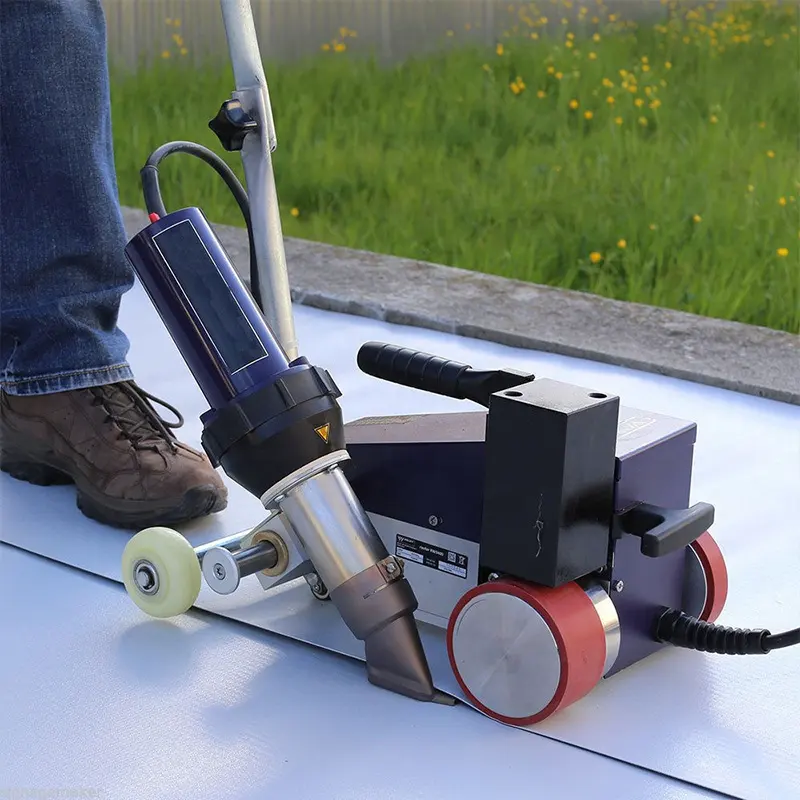
All three types join by hot-air welding with a 40mm minimum overlap, producing a joint as strong as the sheet. Any pvc sheet waterproof membrane fuses to itself; the polyester reinforcement stays out of the weld zone, so the seam behaves as continuous PVC. The rated seam shear value gives site QC a benchmark — a coupon cut from a finished lap can be tested against the published ≥ 900 N/50mm figure. Type L adds a polyester fleece backing for adhesive bonding — fleece peel ≥ 100 N/50mm with PU adhesive, PVC layer tensile ≥ 700 N/50mm. Any pvc waterproof membrane you buy should arrive with test reports matching these fields.
The homogeneous pvc membrane earns its place where geometry and chemistry dominate. Published applications include metro, rail and utility tunnel linings, where the unreinforced sheet conforms to irregular shotcrete and welds in confined spaces. The same through-body structure suits containment ponds, secondary containment basins and sewage works, where resistance to dilute acids, alkalis and sewage is specified. A third use is complex detailing — pipe penetrations, parapets, expansion joints — where the sheet heat-forms around profiles because no fabric layer can split. Whenever the membrane must stretch and form rather than resist load, this grade is correct, and a sheet with polyester reinforcement adds cost without benefit.
Type P is the published specification for mechanically fastened flat roofing on large commercial spans: logistics centers, plants, institutional buildings, where ≥ 900 N/50mm tensile — the polyester reinforcement's contribution — supports wide fastener spacing under wind uplift. Below grade the same pvc waterproof membrane serves basement retaining walls, podium slabs and tunnel liners, with published use under bridge deck pavement where ≥ 15% elongation absorbs deflection. Type L, with its fleece backing, is the published system for fully adhered roofs over PIR or EPS insulation, with no fasteners through the foam. For an engineer comparing pvc roofing membrane options for a warehouse re-roof, this pvc sheet waterproof membrane grade brings documentation — seam shear, dimensional stability, wind performance — that a homogeneous pvc membrane cannot match, and that any pvc waterproof membrane buyer should compare line by line.
Selection follows the dominant project condition. Movement and complex geometry: the homogeneous grade, with ≥ 250% elongation doing the work. Mechanical load from wind or ground: Type P, where the polyester reinforcement and ≤ 0.1% dimensional stability hold the system together. Adhered assemblies over insulation: Type L, whose fleece delivers the published ≥ 100 N/50mm peel with PU adhesive. Thickness follows exposure: 1.2mm–1.5mm for interior and protected work, 1.8mm–2.0mm where the pvc sheet waterproof membrane faces ballast, traffic or hydrostatic pressure. Whether the project needs a homogeneous pvc membrane or a reinforced type, buy against the published fields — tensile, elongation, dimensional stability, water tightness, seam shear — and any pvc roofing membrane comparison becomes a document check.
Follow the exposure: 1.2mm–1.5mm for protected or interior work, 1.8mm–2.0mm for ballasted, loaded or below-grade conditions — wherever wind uplift applies to a pvc sheet waterproof membrane, the polyester reinforcement type is safer.
Yes, where formability matters — flashings and details — but a PVC membrane carrying wind load should be the reinforced Type P, unlike a homogeneous pvc membrane.
Every pvc waterproof membrane here welds by hot air with a minimum 40mm overlap; a pvc roofing membrane with fleece backing bonds to the substrate with PU adhesive, while homogeneous seams weld from any face or direction.

2026/11/20
How an APP waterproof membrane handles heat: 130°C softening point, torch application windows, overheating signs, summer storage, and thermal aging checks.

2026/11/20
The science of a breathable waterproof membrane: water vapor diffusion, Sd values, three grammage grades, water column resistance, and wrong-use cases.

2026/11/20
Single-ply or two-ply, every flat roof is a stack. See how a self adhesive waterproof membrane for roof systems handles base, cap, insulation and drains.

2026/11/20
How the polyester scrim sets tensile strength and dimensional stability of reinforced TPO membrane rolls, with welding, roll sizes and selection tips.

2026/11/20
How an aluminum foil coated bitumen waterproof membrane reflects solar radiation, lowers surface temperature, and what maintenance keeps savings alive.

2026/11/20
SBS modified bitumen waterproof membrane property groups: tensile strength, low-temperature flexibility, heat resistance, surface finishes, applications.
Links to the corresponding full news page.

The eight questions overseas buyers ask most — factory ownership, capacity, batch consistency and lead times, answered straight.

SBS membranes, polymer sheets, coatings and geomembranes — six product lines are operating simultaneously.

Pre-sales specification, on-site technical support and post-delivery maintenance across 100+ export markets.

Waterproofing performance is decided in the specification and the detailing, not just the material. Our technical team helps you select the right system, resolve site questions as they arise, and stay reachable long after the container lands.
