 EN
APP Waterproof Membrane: High-Temperature Stability Guide
2026/11/20
How an APP waterproof membrane handles heat: 130°C softening point, torch application windows, overheating signs, summer storage, and thermal aging checks.

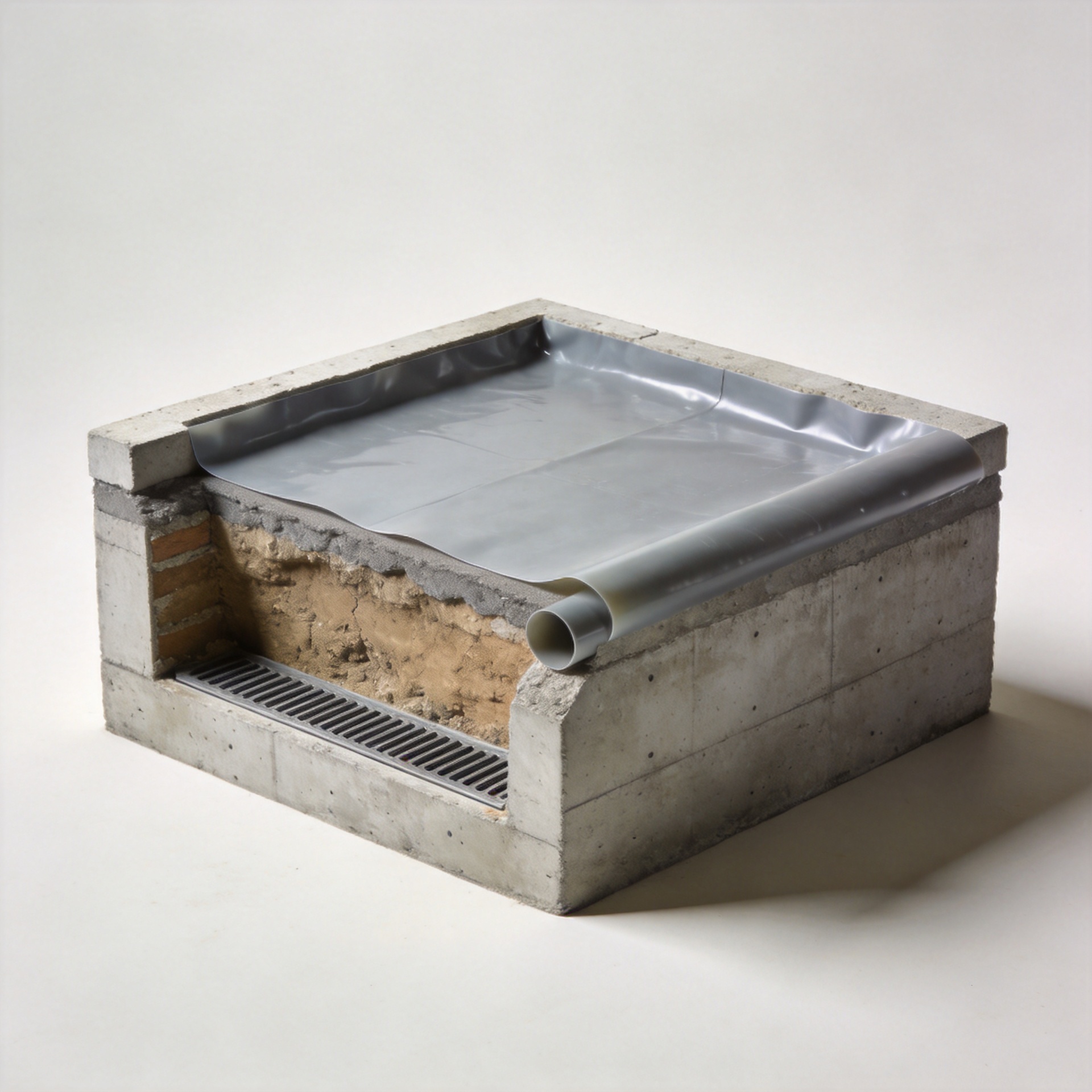
Waterproofing a basement is a system problem, and the system is short: sheet, weld, test, waterstop, and a protection layer. The membrane is the only one of the five a buyer sees on a pallet. The rest are made on site, in whatever weather the programme brings, which is why tanks fail at details rather than in the field.
The membrane is the visible component and rarely the interesting one. A PVC waterproof membrane for basement tanking sits inside a build-up of prepared substrate, a welded seam at every joint, seam testing before anything is covered, a waterstop at each construction joint, and a protection layer that survives backfill. The order is fixed by the structure rather than the supplier: walls, details, testing, protection, fill.
The homogeneous sheet, Type H at 1.2–2.0 mm, carries elongation ≥250%, tensile strength ≥200 N/50 mm, dimensional stability ≤2.0%, flexibility at -25°C and heat resistance at 70°C, with water tightness at 60 kPa to EN 1928 under EN 13956 and GB 12952. Those values suit detailing, because a homogeneous PVC waterproof membrane for basement tanking folds into corners and pipe collars without a fabric fighting the fold. Type P trades elongation for strength: ≥900 N/50 mm along the roll, ≥800 N/50 mm across, dimensional stability ≤0.1%, seam shear ≥900. At a construction joint in a long slab, that stability and seam shear decide the weld detail, and both grades often appear in one tank.
Every joint is a welded seam, and it is a potential leak until seam testing says otherwise. The published lap is 40 mm, enough for a double weld: two parallel runs with an unfilled channel between them. That channel is why the system can be tested at all, and it is the detail most often lost when a crew closes it by overheating with a nozzle held too long in one spot. A seam closed flat with a hand roller leaves nothing to test, and the defect shows years later as a damp patch at the foot of a wall. A skipped protection layer undoes all of it in one backfill pass. On a wall that meets a construction joint, the weld turns the corner first and the joint detail second, in that order.
Seam testing is a production step, not a final inspection. Air enters the channel between two welds and is held; a pressure drop means a path exists, and the leak can be found by ear or by wetting the seam. Vacuum testing covers a single welded seam where no channel exists, and a destructive probe on a sample confirms what the non-destructive methods imply. No protection layer goes down until seam testing is signed off. A crew that tests after backfill is guessing, and the guess is charged to the next budget. For a PVC waterproof membrane for basement tanking, every result is logged against a seam number.
A construction joint is where two pours meet and where water arrives first. The detail depends on a waterstop cast into the joint, with the sheet welded across it and a movement allowance each side. A missed cast-in waterstop can be replaced by a PVC strip welded across the joint, but that added welded seam must pass seam testing twice before cover goes on. A construction joint that moves needs a different treatment from one that does not, and the sheet should never be the only element bridging it. Tie holes, pipe penetrations and pile caps follow the same logic: collar, weld, test, record. On a PVC waterproof membrane for basement tanking the details carry more risk than the field sheet, so the drawing set deserves more attention than the datasheet.
Water tightness at 60 kPa is a test value, not a depth rating. What the sheet can do is resist the pressure it was tested at, provided the protection layer keeps backfill off it and drainage takes water away. On a wall, a studded sheet of 20–25 mm does both jobs. Backfill in lifts and never drop stone against a PVC waterproof membrane for basement tanking; it is not a cushion. Where the water table sits above the slab, the tank is under constant head and every penetration is a permanent liability; where it sits below, the sheet still has to survive fill, site traffic and the welded seam repairs that follow. Flood testing before backfill is the last chance, and a falling level at a construction joint points to a detail rather than to the field sheet.
Neither is better in general. Type H suits complex geometry and repair work; Type P suits long slabs where dimensional stability and seam shear govern. Many tanks use both, with a PVC waterproof membrane for basement tanking specified as reinforced sheet in the field and homogeneous sheet at details.
By air pressure in the channel of a double weld, by vacuum on a single weld, and by a destructive probe on a sample. The three together cover production quality, and none replaces the written record that seam testing leaves behind.
Yes. A PVC waterproof membrane for basement tanking that is buried behind fill cannot be inspected again, so the layer takes the point load of compaction and keeps stone off the sheet, and the damage it prevents is invisible to any test performed after the fill.

2026/11/20
How an APP waterproof membrane handles heat: 130°C softening point, torch application windows, overheating signs, summer storage, and thermal aging checks.

2026/11/20
The science of a breathable waterproof membrane: water vapor diffusion, Sd values, three grammage grades, water column resistance, and wrong-use cases.

2026/11/20
Single-ply or two-ply, every flat roof is a stack. See how a self adhesive waterproof membrane for roof systems handles base, cap, insulation and drains.

2026/11/20
How the polyester scrim sets tensile strength and dimensional stability of reinforced TPO membrane rolls, with welding, roll sizes and selection tips.

2026/11/20
How an aluminum foil coated bitumen waterproof membrane reflects solar radiation, lowers surface temperature, and what maintenance keeps savings alive.

2026/11/20
SBS modified bitumen waterproof membrane property groups: tensile strength, low-temperature flexibility, heat resistance, surface finishes, applications.
Links to the corresponding full news page.

The eight questions overseas buyers ask most — factory ownership, capacity, batch consistency and lead times, answered straight.

SBS membranes, polymer sheets, coatings and geomembranes — six product lines are operating simultaneously.

Pre-sales specification, on-site technical support and post-delivery maintenance across 100+ export markets.

Waterproofing performance is decided in the specification and the detailing, not just the material. Our technical team helps you select the right system, resolve site questions as they arise, and stay reachable long after the container lands.
