 EN
APP Waterproof Membrane: High-Temperature Stability Guide
2026/11/20
How an APP waterproof membrane handles heat: 130°C softening point, torch application windows, overheating signs, summer storage, and thermal aging checks.

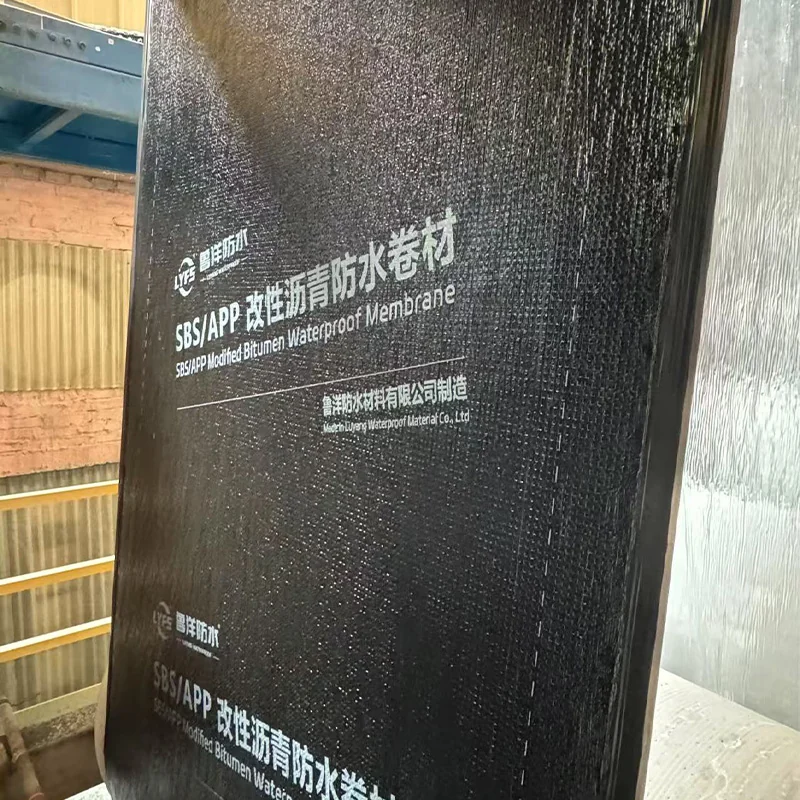
The catalogue carries no separate page for a self-adhesive SBS sheet, and that omission is informative: the adhesive inside the cold roll is the same polymer used in the torch grades, so the question is delivery rather than chemistry.
An sbs self adhesive waterproof membrane roll is a delivery format, not another chemistry. The modifier is styrene-butadiene-styrene, the reinforcement is polyester, and the difference is how the sheet reaches the deck. An sbs modified bitumen membrane prepared for torching carries 3 mm, 4 mm or 5 mm of compound so it can take heat and still leave body behind. A torch applied waterproof membrane of that build fuses to the substrate and to its neighbour. The cold applied bitumen membrane version carries 1.2 mm or 1.5 mm, because adhesive replaces flame. The membrane lap joint tells the same story in miniature: pressure in one case, fusion in the other.
The 1.2 mm film-faced sbs self adhesive waterproof membrane roll publishes peel adhesion ≥1.5 N/mm to concrete, tensile strength ≥300 N/50mm, elongation ≥30%, low-temperature flexibility -20°C and water tightness 0.3 MPa held for 120 minutes; the 1.5 mm granule-faced cold applied bitumen membrane reaches ≥400 N/50mm, 90°C heat resistance and -15°C. Set that beside an sbs modified bitumen membrane torch sheet at ≥800 N/50mm, ≥40% elongation and -25°C, and the trade is plain: the sbs self adhesive waterproof membrane roll gives up more than half its tensile strength and five degrees of cold margin for 1.2 mm of build-up. A torch applied waterproof membrane is stronger because it is thicker, not because the polymer differs. A cold applied bitumen membrane earns its place where height and flame are the constraints, and its membrane lap joint needs pressure rather than heat.
Heavy maintenance traffic, plant rooms, parking decks and roofs walked in service belong to the thicker sheet. Five millimetres of sbs modified bitumen membrane carries puncture reserve no 1.2 mm roll can match, and the -25°C rating matters where installation runs below freezing. A torch applied waterproof membrane also follows minor substrate profile, because the compound softens under the flame. Where a specification calls for GB 18242 or EN 13707 at 5 mm, an sbs self adhesive waterproof membrane roll is not a substitute, and the lap detail will have been drawn for fusion. A cold applied bitumen membrane remains the right answer at the detail, not across the field.
Laps are where the systems diverge. A cold roll relies on a factory adhesive edge, contact pressure and a roller, so every membrane lap joint depends on cleanliness and on pressure reaching the full overlap. A torch sheet melts its own bitumen, so the seam is fused with no adhesive interface at all. Neither forgives contamination. Inspection differs as well: a cold applied bitumen membrane seam can be probed and lifted soon after rolling, while a torch applied waterproof membrane seam is checked once cooled. Because an sbs modified bitumen membrane is the parent material in both, seam failure usually traces to workmanship rather than chemistry, and the roll is only as good as the roller behind it.
Cold rolls shorten the critical path on occupied buildings, because there is no hot-work permit, fire watch or gas supply to arrange, and no membrane lap joint waiting on a flame guard. An sbs self adhesive waterproof membrane roll can be laid in a plant room or hospital wing while the space below stays in use. The sbs modified bitumen membrane torch route needs permits, standby cover and a cleared area, which is often the real constraint rather than material cost.
A retail refurbishment above trading floors shows the split: no hot-work permit could be issued, so a cold applied bitumen membrane closed the roof over a weekend while the torch applied waterproof membrane stayed in the yard. Either way, the membrane lap joint is the part of the programme that cannot be rushed.
Write the specification by position rather than habit. Details, internal wet areas and repair patches suit an sbs self adhesive waterproof membrane roll; exposed fields, traffic zones and build-ups above 5 mm suit the torch sheet. An sbs modified bitumen membrane schedule naming both formats stops substitution, and a stated membrane lap joint detail ends the argument about method. Confirm whether the cold applied bitumen membrane will be covered or left visible, since that decides face and heat resistance. State the standard too, because a torch applied waterproof membrane is commonly specified to GB 18242 or EN 13707 while the cold roll is quoted on its own datasheet.
Yes. The adhesive compound in the cold rolls is SBS modified bitumen with polyester reinforcement. The catalogue lists it by application format rather than by polymer.
Only where the build-up and exposure suit it. A 1.2 mm or 1.5 mm cold roll is not equivalent to a 4 mm or 5 mm torch sheet on a traffic-bearing roof, since an sbs modified bitumen membrane at 4 mm is a different system.
Cold rolls come at 1.2 mm with a PE film face and 1.5 mm with coloured mineral granules, on 1 m × 10 m rolls. Torch sheets come at 3 mm, 4 mm and 5 mm on 1 m × 10 m or 1 m × 7.5 m rolls.

2026/11/20
How an APP waterproof membrane handles heat: 130°C softening point, torch application windows, overheating signs, summer storage, and thermal aging checks.

2026/11/20
The science of a breathable waterproof membrane: water vapor diffusion, Sd values, three grammage grades, water column resistance, and wrong-use cases.

2026/11/20
Single-ply or two-ply, every flat roof is a stack. See how a self adhesive waterproof membrane for roof systems handles base, cap, insulation and drains.

2026/11/20
How the polyester scrim sets tensile strength and dimensional stability of reinforced TPO membrane rolls, with welding, roll sizes and selection tips.

2026/11/20
How an aluminum foil coated bitumen waterproof membrane reflects solar radiation, lowers surface temperature, and what maintenance keeps savings alive.

2026/11/20
SBS modified bitumen waterproof membrane property groups: tensile strength, low-temperature flexibility, heat resistance, surface finishes, applications.
Links to the corresponding full news page.

The eight questions overseas buyers ask most — factory ownership, capacity, batch consistency and lead times, answered straight.

SBS membranes, polymer sheets, coatings and geomembranes — six product lines are operating simultaneously.

Pre-sales specification, on-site technical support and post-delivery maintenance across 100+ export markets.

Waterproofing performance is decided in the specification and the detailing, not just the material. Our technical team helps you select the right system, resolve site questions as they arise, and stay reachable long after the container lands.
