 EN
APP Waterproof Membrane: High-Temperature Stability Guide
2026/11/20
How an APP waterproof membrane handles heat: 130°C softening point, torch application windows, overheating signs, summer storage, and thermal aging checks.

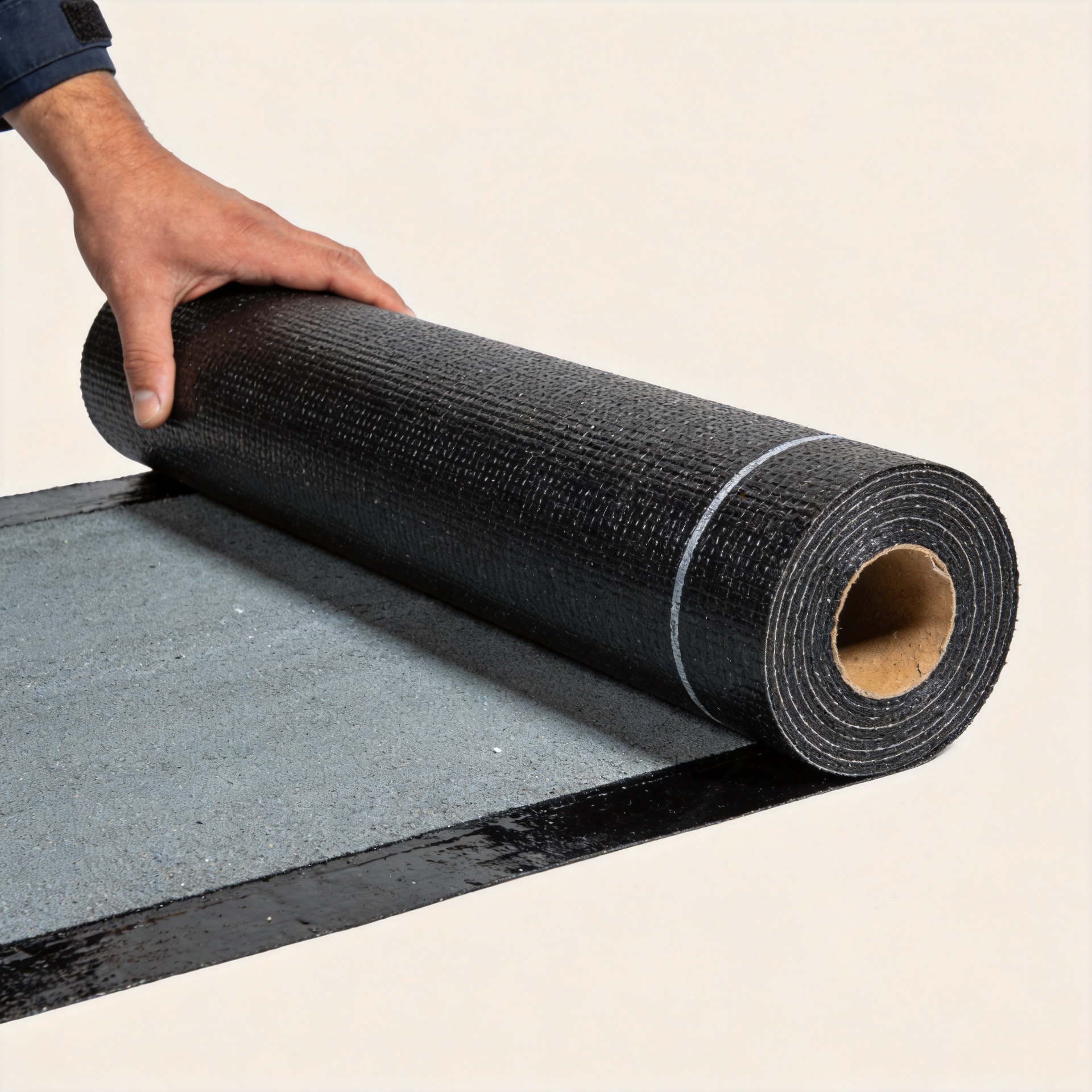
A roof leak is often blamed on the sheet, yet the failure usually sits at an interface. A self adhering sbs modified bitumen roofing system treats primer, base, cap, tape and edge fixing as one design problem rather than a pile of parts. Every layer is checked against the next, and every joint has an owner. That is the practical difference between a cold applied roofing package and a membrane sold by the metre.
A two-layer build starts with a bitumen primer on a prepared deck. The base is a self-adhesive sheet with a polyethylene film face; the self adhesive cap sheet carries mineral granules and forms the weather surface. Both rely on bitumen flashing tape at laps and penetrations, plus mechanical fixing at perimeters. The cap and base meet at every lap through that tape, so the joint belongs to the tested assembly. The self adhering sbs modified bitumen roofing system is defined by that list, not by the cap alone, and an sbs modified bitumen membrane used as a torch-applied alternative follows the same detailing logic.
Cold applied roofing depends on primer chemistry more than on sheet thickness. The primer turns a dusty substrate into a consistent bonding face and controls how fast the adhesive wets it. The base carries the waterproofing duty and bridges minor cracks; the cap takes ultraviolet exposure and thermal cycling. A 1.2 mm self-adhesive base reaches at least 1.5 N/mm peel and passes 0.3 MPa for 120 minutes at -20°C. A 1.5 mm self adhesive cap sheet reaches at least 1.5 N/mm and 400 N/50mm tensile, holds at 90°C and stays flexible to -15°C. Where an sbs modified bitumen membrane is chosen as the cap, the sheet is rated at 800 N/50mm, 40% elongation and -25°C. Layer order inside a self adhering sbs modified bitumen roofing system matters more than any single value.
Bitumen bonds to bitumen, but not every compound is interchangeable. A cap plasticized for cold flexibility can migrate plasticizer into a base sheet, and a solvent primer can attack a thin film before it flashes off. Check the compound family of each layer, the primer type and open time, and whether the supplier lists base and cap as a tested pair. An sbs modified bitumen membrane tested only against its own brand proves little. Mixed-brand work is possible, but responsibility for that cold applied roofing assembly, and for the self adhering sbs modified bitumen roofing system as a whole, then moves to the specifier.
Details decide survival in the first winter. At parapets the membrane turns up the wall and terminates in a fixed edge. At laps, a bitumen flashing tape bridges the transition. A 1.5 mm aluminum foil tape in widths from 100 to 600 mm and lengths from 7.5 to 20 m gives at least 1.5 N/mm peel and 400 N/50mm tensile. For wide structural joints, a 2.0 mm butyl tape from 300 to 1000 mm reaches 2.0 N/mm and passes 0.4 MPa, with flexibility from -40°C to +80°C. Where the cap is a self adhesive cap sheet, the same edge detail applies as for an sbs modified bitumen membrane. In a self adhering sbs modified bitumen roofing system, edge fixing stays mechanical and spaced to the wind load, with the tape sealing the fixing line.
Ask for a datasheet naming every layer with thickness and measured values, a compatibility statement covering primer, base, self adhesive cap sheet and bitumen flashing tape, and test reports to GB 18242 or EN 13707. Batch certificates trace each roll to a production date. For cold applied roofing in occupied buildings, the file should confirm that no flame is used at any interface. One manufacturer for the full self adhering sbs modified bitumen roofing system removes the argument about whose layer failed, and Dingtai supplies such assemblies from a single site.
Two failures recur: layers chosen for appearance, and a cap heavier than needed. Start from the deck, slope, foot traffic and lowest site temperature. A smooth concrete deck rarely needs a thick cap. Edge metal and bitumen flashing tape complete the perimeter, and the tape seals every fixing line. Where winter design sits below the cap limit, move to a colder grade or keep the mineral cap over a base rated colder. Write the layer sequence of the self adhering sbs modified bitumen roofing system, lap width and fixing pattern into one drawing. A facilities team refurbishing a coastal warehouse specified a single-layer self adhesive cap sheet over a metal deck. The deck became concrete mid-project, so the build moved to a two-layer cold applied roofing assembly with a 1.2 mm base, a re-detailed sbs modified bitumen membrane cap and fresh bitumen flashing tape at the perimeter.
On porous or dusty concrete, yes. The primer stabilises the surface and gives the adhesive a consistent face. On clean steel or existing bitumen, a dry surface may be approved instead.
Often yes, after the old surface is cleaned and loose granule removed. The new sheet then becomes the weather layer, lapped and dressed with bitumen flashing tape, while the existing sbs modified bitumen membrane acts as the base.
Two layers suit most exposed roofs with complex detailing. One is enough on smooth decks with simple perimeters, provided the cap thickness and the flashing detail are specified together.

2026/11/20
How an APP waterproof membrane handles heat: 130°C softening point, torch application windows, overheating signs, summer storage, and thermal aging checks.

2026/11/20
The science of a breathable waterproof membrane: water vapor diffusion, Sd values, three grammage grades, water column resistance, and wrong-use cases.

2026/11/20
Single-ply or two-ply, every flat roof is a stack. See how a self adhesive waterproof membrane for roof systems handles base, cap, insulation and drains.

2026/11/20
How the polyester scrim sets tensile strength and dimensional stability of reinforced TPO membrane rolls, with welding, roll sizes and selection tips.

2026/11/20
How an aluminum foil coated bitumen waterproof membrane reflects solar radiation, lowers surface temperature, and what maintenance keeps savings alive.

2026/11/20
SBS modified bitumen waterproof membrane property groups: tensile strength, low-temperature flexibility, heat resistance, surface finishes, applications.
Links to the corresponding full news page.

The eight questions overseas buyers ask most — factory ownership, capacity, batch consistency and lead times, answered straight.

SBS membranes, polymer sheets, coatings and geomembranes — six product lines are operating simultaneously.

Pre-sales specification, on-site technical support and post-delivery maintenance across 100+ export markets.

Waterproofing performance is decided in the specification and the detailing, not just the material. Our technical team helps you select the right system, resolve site questions as they arise, and stay reachable long after the container lands.
