 EN
APP Waterproof Membrane: High-Temperature Stability Guide
2026/11/20
How an APP waterproof membrane handles heat: 130°C softening point, torch application windows, overheating signs, summer storage, and thermal aging checks.

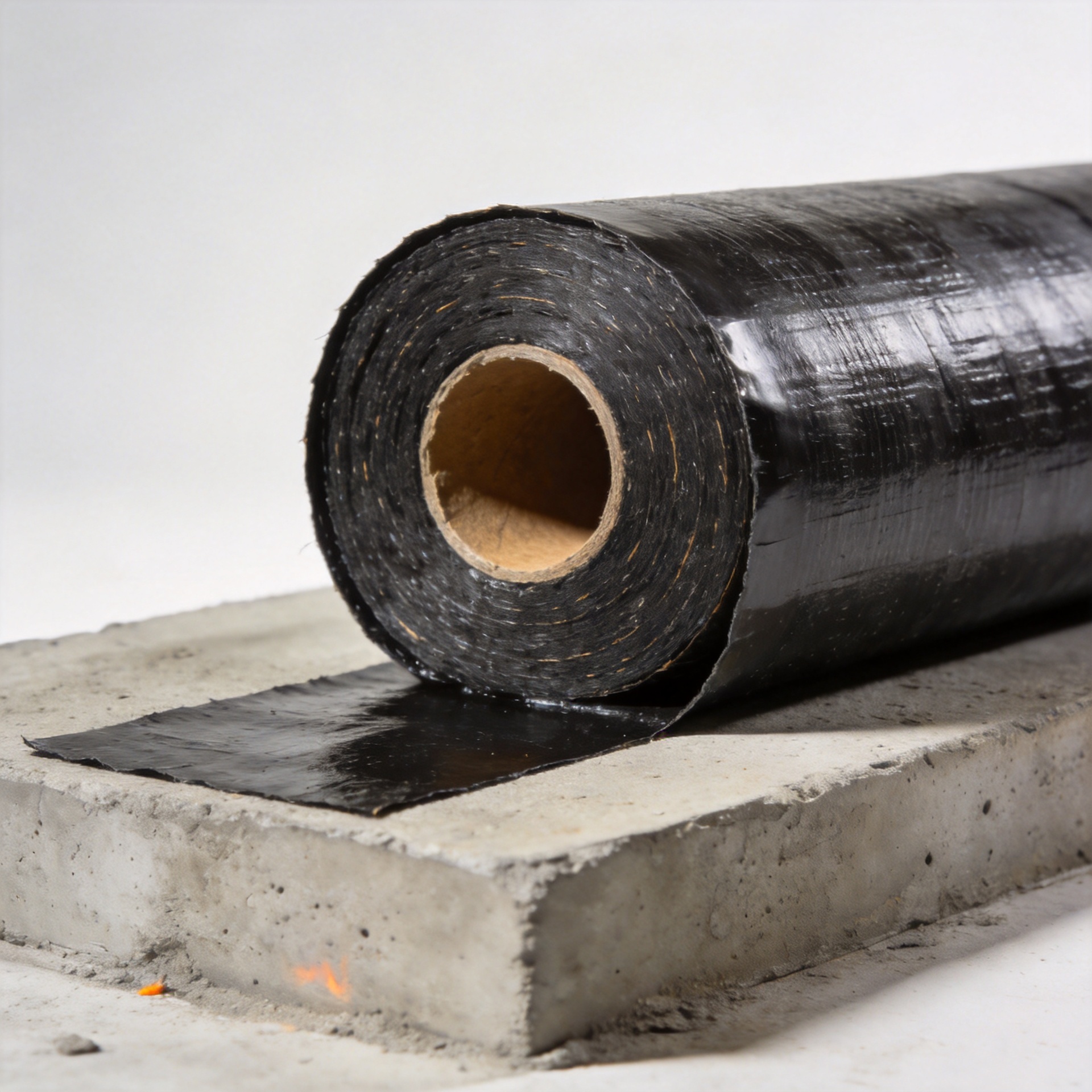
Every waterproofing system lives or dies by the bond between sheet and substrate, and most systems buy that bond with heat: torch, hot air, or a kettle of boiling asphalt. Cold-applied waterproofing takes another route: the adhesive arrives factory-applied, and the bond forms at ambient temperature under pressure alone. For this product family the bond is the entire installation method, so the material science deserves attention.
The underside of a self-adhesive waterproof membrane carries a pressure-sensitive adhesive: a bituminous compound formulated to stay permanently tacky. Pressure-sensitive adhesion is a physical process, not a chemical reaction. Pressed onto a primed substrate, the adhesive flows into the microscopic pores and texture of the surface — wetting it the way water wets paper — and molecular attraction across that intimate contact does the rest. No compound cools from a molten state, no solvent evaporates, nothing cures — unusual behavior for a pressure-sensitive adhesive. The adhesive is ready the moment the release film comes off, which is why peel adhesion is measured on samples pressed at room temperature, not on heated ones. Roll the sheet down firmly and the bond already exists; there is no activation threshold to reach, and the same softness that wets a substrate lets it close small defects later.
A cured, heavily filled sheet stays holed wherever a fastener pierces it. A self-adhesive waterproof membrane reacts differently: its tacky mass flows around the intrusion and re-seals the path, so a shallow cut or withdrawn screw stops being permanent. Overlaps show the same behavior: laps self-bond under pressure — the pressure-sensitive adhesive simply joins to itself — so a seam is a continuation of the sheet, not a joint at the mercy of flame control. Self-healing of this kind is not a repair service; it is the same wetting mechanism applied to a defect, and it works only while the compound stays soft. A representative 1.5mm colored-mineral-sand grade lists peel adhesion of at least 1.5 N/mm among its certified figures, produced under ISO 9001 with CE certification.
Because nothing is heated and nothing cures, cold-applied waterproofing compresses programs in visible ways. Work proceeds inside occupied buildings and fire-restricted sites where open flame is barred. There is no kettle to erect, no fire watch after hours, no waiting before the next layer follows. On a hospital refurbishment, the contractor chose a self-adhesive waterproof membrane for the balconies because hot-work permits in an operating building would have stalled the program; peel-and-press installation let a smaller team keep output steady; the pressure-sensitive adhesive needs no cure clock. The thinner 1.2mm PE-film grade extends the same logic indoors: its tile-adhesive-compatible surface lets tiling follow immediately once the cold-applied waterproofing has been rolled down, and water tightness is tested at 0.3 MPa for 120 minutes, the self-healing compound needing no cure before it works.
A torch-applied bond is an operator product: flame speed, torch angle, judgment about the bitumen's state. A bond made by a pressure-sensitive adhesive is a system product: primer, rolling pressure, substrate condition — inputs a contractor can specify, train for, and inspect. That consistency is a quiet reason cold-applied waterproofing is favored for details, corners, and confined areas, where supervision is hardest and rework is most expensive. With this adhesive, the peel adhesion acceptance test is identical whether the sheet is applied by a senior crew or a new one — the product defines the bond, and the crew defines only the preparation. Uniform tack also means uniform repair reserves across the whole field, not just where a careful installer worked.
The published data make the mechanism of a self-adhesive waterproof membrane readable, and they show what cold-applied waterproofing can promise. The 1.5mm mineral-sand grade carries tensile strength of at least 400 N/50mm, elongation at break of at least 30%, low-temperature flexibility of -15°C, and heat resistance of 90°C, with peel adhesion of 1.5 N/mm quoted for both sheets. The 1.2mm PE-film grade matches that peel figure, flexes to -20°C, and passes the 0.3 MPa, 120-minute water-tightness test for concealed positions. Different thicknesses and finishes — one bonding logic underneath both. For a buyer, that means cold-applied waterproofing scales by grade without changing the bonding physics.
Honest limits complete the science. The mechanism rewards smooth, clean, dry, primed surfaces and punishes the opposite: on rough, dusty, or damp substrates the pressure-sensitive adhesive cannot wet the surface fully and peel adhesion never develops, so a torch-applied membrane may give the more reliable bond — the 1.5mm product page says exactly this. Cold substrates thicken the adhesive and cut its tack, bounding the winter window for cold-applied waterproofing unless sheets and base are conditioned. Oil or loose laitance weakens the wetting the mechanism rests on; self-healing covers small intrusions, never a badly prepared substrate. On large exposed roof fields, cap-sheet duty under full sun still belongs to torch-applied systems; this product earns its keep where the bond is achievable and flame is not — balconies, wet rooms, basements, details, secondary layers.
Its pressure-sensitive adhesive forms a physical bond on contact: pressing makes the compound wet the primed surface immediately, with no chemical reaction, solvent loss, or cooling involved.
No. The tacky compound re-seals small penetrations and shallow cuts; larger damage still needs a patch, which bonds like the original lap.
Smooth, sound, dry concrete or screed with primer, where peel adhesion develops fully. Rough, damp, or dusty bases stop the adhesive wetting; there a torch-applied system is often safer.

2026/11/20
How an APP waterproof membrane handles heat: 130°C softening point, torch application windows, overheating signs, summer storage, and thermal aging checks.

2026/11/20
The science of a breathable waterproof membrane: water vapor diffusion, Sd values, three grammage grades, water column resistance, and wrong-use cases.

2026/11/20
Single-ply or two-ply, every flat roof is a stack. See how a self adhesive waterproof membrane for roof systems handles base, cap, insulation and drains.

2026/11/20
How the polyester scrim sets tensile strength and dimensional stability of reinforced TPO membrane rolls, with welding, roll sizes and selection tips.

2026/11/20
How an aluminum foil coated bitumen waterproof membrane reflects solar radiation, lowers surface temperature, and what maintenance keeps savings alive.

2026/11/20
SBS modified bitumen waterproof membrane property groups: tensile strength, low-temperature flexibility, heat resistance, surface finishes, applications.
Links to the corresponding full news page.

The eight questions overseas buyers ask most — factory ownership, capacity, batch consistency and lead times, answered straight.

SBS membranes, polymer sheets, coatings and geomembranes — six product lines are operating simultaneously.

Pre-sales specification, on-site technical support and post-delivery maintenance across 100+ export markets.

Waterproofing performance is decided in the specification and the detailing, not just the material. Our technical team helps you select the right system, resolve site questions as they arise, and stay reachable long after the container lands.
