
 EN
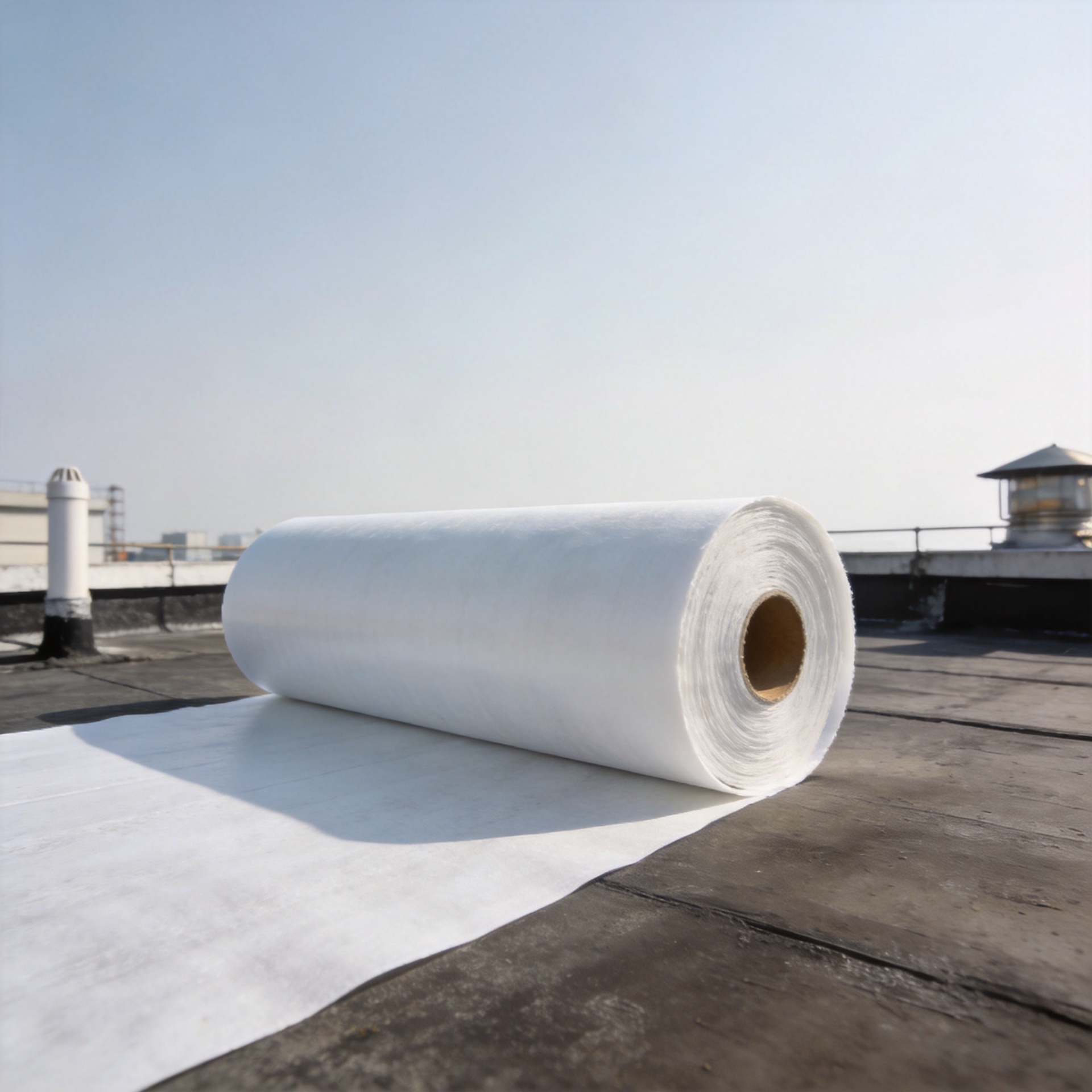
A single-ply roof fails at interfaces, not in the middle of a roll. A TPO single ply waterproofing membrane system is the sheet plus the fastening, the seams, the terminations and the flashings, and it is commissioned as one assembly or not at all. What follows explains the two published constructions, the seam logic, colour, and the thickness matrix that ties attachment to sheet gauge.
The System, Not the Roll
Start below the sheet. Deck, insulation and often a separate vapor retarder each carry their own fixing pattern, and the layer above inherits every error. Then the membrane layer, where plates and screws work at a published density, adhesive beds the sheet, or ballast holds it down. In a TPO single ply waterproofing membrane system the interfaces fail first, so a homogeneous TPO membrane laid over a soft substrate shows every plate as a wear point. White surfaces carry a solar reflectance index, but no figure of that kind repairs a plate pattern, and the seams that hot air welding closes are only as good as the substrate beneath them.
Two Constructions, Two Jobs
Both builds come in 1.2mm, 1.5mm, 1.8mm and 2.0mm. A homogeneous TPO membrane is unreinforced: 100 N/50mm tensile to EN 12311-2, 300% elongation, 2.0% dimensional stability to EN 1107-2. A polyester reinforced TPO sheet carries a scrim: 250 N/50mm, 15% elongation, 0.5% stability. The first drapes into corners and follows curved upstands; the second resists traffic, point loads and the daily movement of a wide field. Both are supplied in white with a published solar reflectance index. Neither is better in the abstract, and a quote that names a gauge but not a construction has said very little.
Why the Weld Is the Product
A single-ply roof has no factory edge, only seams, and that is where a TPO single ply waterproofing membrane system earns or loses its warranty. Hot air welding heats both surfaces and presses them together while the polymer is molten; with the right overlap, clean laps, controlled air temperature and steady roller pressure, the joint ends up as watertight as the sheet. Machine work holds speed across long runs, hand work reaches curbs and corners, and a polyester reinforced TPO sheet runs differently under the rod than an unreinforced one, because the scrim pulls heat away from the interface.
White Surface and Cooling Load
The white face of a TPO single ply waterproofing membrane system is published with a solar reflectance index of at least 104; light grey and tan are also available. That figure lowers surface temperature under sun, which reduces heat flow through the insulation and the daily expansion that works on seams. The gain is largest where cooling dominates and insulation is modest, smallest on a heavily insulated roof in cool climates. Read it as a property of the delivered surface, not an energy guarantee, and note that the polyester reinforced TPO sheet wears the same white face as the unreinforced one.
Attachment Dictates Thickness
Attachment and thickness are published together and are not interchangeable. Mechanical fastening is listed for 1.2mm, 1.5mm and 1.8mm; fully adhered for 1.2mm and 1.5mm; ballasted for 1.5mm, 1.8mm and 2.0mm. A ballasted roof needs thickness against gravel abrasion, and a white surface with a high solar reflectance index does not compensate for a thin sheet. An adhered roof needs a conformable sheet, which is where a homogeneous TPO membrane earns its place. Specify outside the matrix and the polyester reinforced TPO sheet has no published basis, whatever the hot air welding achieves on site.
Handover and a Project Note
At handover of a TPO single ply waterproofing membrane system ask for four things: an as-built seam layout, probe and sample results for every seam run, photographs of terminations and curb details, and confirmation that drain rings have the membrane dressed into them rather than cut around. On a food processing plant roof in a hot, dusty district, probe testing found three hand-welded seams at equipment curbs closed too quickly, with a visible gap under the lap. Nothing had leaked. A contractor working with Shandong Dingtai Waterproof cut them back, cleaned, re-welded with a pressure roller and a second operator, and re-tested. A homogeneous TPO membrane at the curbs held on the second pass. Defects in a welded assembly can be found before water arrives, provided the build, hot air welding included, is handed over with the solar reflectance index of the installed surface on file.
Frequently Asked Questions
Is a thicker sheet the better choice?
No. In any TPO single ply waterproofing membrane system thickness follows attachment: 1.2mm to 1.8mm for mechanical fastening, 1.2mm and 1.5mm for adhered, 1.5mm to 2.0mm for ballasted, and neither route changes how hot air welding is planned. A homogeneous TPO membrane at 1.2mm outperforms a thicker sheet on a curved upstand it cannot follow, and a polyester reinforced TPO sheet is wasted on detailing.
How is a seam proven before handover?
By probe and by sample. A rounded probe travels the seam edge looking for a lift, and a sample cut from a sacrificial seam shows whether the sheets fused through their full thickness. Both records belong beside the hot air welding log, because they are the only evidence that a TPO single ply waterproofing membrane system was welded rather than merely joined.
Does the white surface matter outside hot climates?
It matters less, though not nothing. A high solar reflectance index reduces surface temperature and thermal cycling wherever the roof sees strong sun, and in a cool climate it still slows heat ageing. A homogeneous TPO membrane in white gains the same way as a polyester reinforced TPO sheet, and any TPO single ply waterproofing membrane system benefits from a cooler surface.










